Become a global human resource who can play an active role in a variety of situations. Acquire "true English skills" that can be used in the international community.
To acquire a high level of English proficiency thorough "foundation building"
In the first year, we build up the "foundation" of English. Vocabulary, English grammar, reading comprehension, writing, and conversational expression are all solidified to build a foundation for acquiring a high level of English proficiency.
2
Practice and transmit the English you learn at anyway
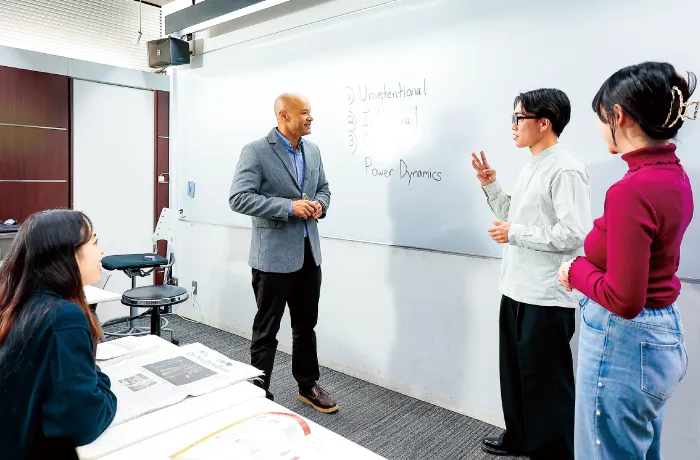
In addition to the common subject "EIC," students will actually use the English they have learned in the course-specific subjects "Japan Studies" and "Debate Exercise. Under the guidance of both Japanese and non-Japanese instructors, students will strengthen their ability to communicate in a well-balanced manner.
3
Certificate of Learning "Qualifications and Certifications"
Students are thoroughly prepared for English-related qualification tests. In addition to the TOEIC® L&R Test administered by all departments, the English major courses require students to take the TOEIC® S&W Tests, which measure output skills.
TOPICS Course Topics
Two years of mastering English in classes suited to your level. Students have ample opportunities to practice the skills they have acquired overseas.
Various Overseas Training Programs
We offer a wide variety of short-term overseas training programs at partner schools and companies. Students can choose the program that best suits their goals from a wide variety of options.
Proficiency classes
In addition to common subjects, students in the English Major Course study specialized course subjects in leveled classes. Classes are reorganized in the first semester of the second year.
PICK UP Introduction of Classes
Interpreter Training
Students will acquire the advanced operational skills in English (vocabulary, grammar, articulation, pronunciation, and fluency) required for interpreting, and the ability to express themselves accurately and clearly when translating.
Business English Exercises
Students will learn business terminology, useful conversational expressions, and writing skills necessary for working in English. We train students to be active in the workplace by making use of English.
Global Englishes
Students will gather information in English about events happening in various parts of the world from the international media. Students will acquire knowledge of current events and cultures while being exposed to a variety of English expressions.
STUDENT'S VOICE What is the unique learning experience at KIFL?
English major, 2nd year Yona Matsumoto From Yamato Nishi High School, Kanagawa Prefecture Offered a job at Shibaya Corporation (textile trading company)
With words as our weapon, we will turn our "love" into a job. I want to bring Japanese fabrics to the world stage.
I decided to enroll in KIFL because I wanted to further improve my English skills, which I had cultivated while studying abroad in the U.S. during my high school years, and be immediately effective in the workforce. I had the option of going on to university, but KIFL was the ideal place for me to learn because I wanted to quickly acquire skills beyond English conversation to become a professional interpreter and translator. What surprised me when I enrolled in KIFL was that I was able to experience different cultures without having to leave Japan. There are many foreign students in my class, and we naturally have lively conversations in English even during breaks. The class that left a particularly strong impression on me was EIC (English for International Communication). The teachers are all unique, and the discussions with teachers of various nationalities were very stimulating and enjoyable. Being able to learn the differences in expressions depending on the country of origin, such as the U.S. or the U.K., was a valuable experience for me to learn the depth of the language. In addition, through training as an interpreter, I realized how difficult and interesting it is to not only replace words but also to convey the culture and intentions behind them. Through this practical study, I was able to increase my TOEIC® score to 940 and also obtain a level 1 English proficiency test. I feel that these qualifications gave me a great advantage in choosing a career path. Thanks to these studies and the generous support of the Career Education Center, I was able to receive a job offer from a textile trading company, which was my first choice. I wanted to work in the fashion industry while communicating in English. In the future, I would like to be in charge of overseas exhibitions and convey the appeal of Japanese fabrics to people around the world.
VIEW MORE
CAREER Qualifications and Career Paths
Aimed Qualifications
National Interpreter Guide
TOEIC® 700 or above
Practical English Proficiency Test Level 1 or above
TOEIC®Speaking 130 or above, TOEIC®Writing 140 or above, TOEFL ITP® 480 or above, United Nations Official English Proficiency Test Level B or above, Microsoft Office Specialist